
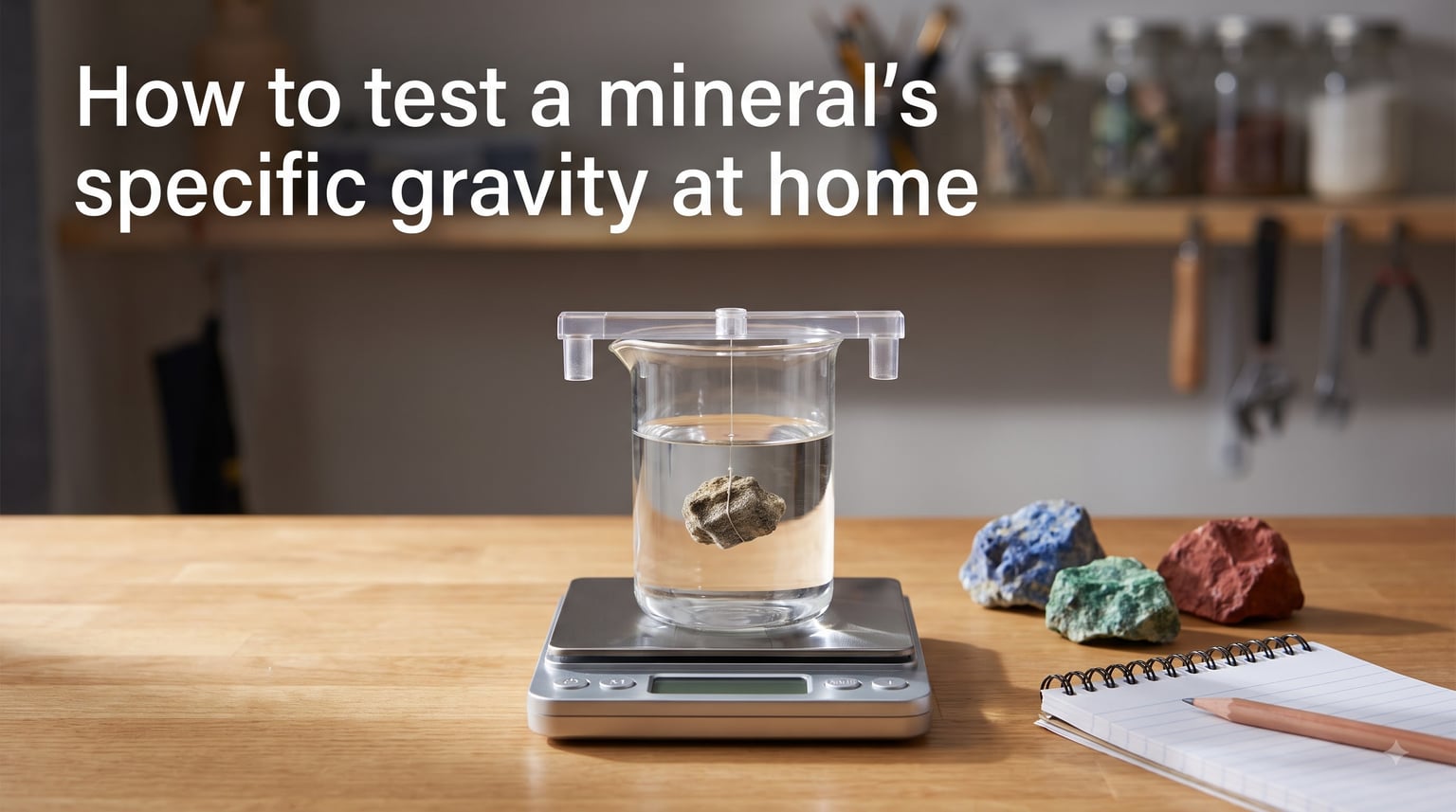
If you have ever picked up an interesting rock on a hike and wondered whether you found something valuable, learning how to test a mineral’s specific gravity at home is the single most useful skill you can pick up. It requires no chemicals, no dangerous equipment, and only a few dollars of gear. I have been testing specimens this way for years, and it has helped me separate look-alike minerals countless times.
This guide walks you through the exact method I use, including the formula, the equipment list, and the small tricks that turn rough numbers into reliable results. Whether you are a beginner rockhound, a lapidary hobbyist, or just curious about that odd-looking stone on your desk, you will be able to measure specific gravity confidently by the end.
Table of Contents
What Is Specific Gravity and Why Does It Matter for Mineral Identification?
Specific gravity is the ratio of a mineral’s density to the density of water. In plain language, it tells you how heavy a mineral feels compared to an equal-sized piece of water. A mineral with a specific gravity of 3.5 weighs three and a half times more than the same volume of water.
This number matters because every mineral has a characteristic specific gravity range. Quartz sits around 2.65, while galena weighs in at about 7.5. When two minerals look identical in color and crystal form, their specific gravity almost always gives them away. It is one of the oldest, most reliable non-destructive tests in geology.
The test works because of the Archimedes principle. When you submerge an object in water, it loses weight equal to the weight of the water it displaces. By weighing your mineral first in air, then while suspended in water, you can calculate how much water it pushed aside, and from that, its specific gravity. No expensive lab gear required.
Specific Gravity vs Density: What’s the Difference?
Density is mass per unit volume, usually expressed in grams per cubic centimeter. Specific gravity is a dimensionless ratio, meaning it has no units. For most practical purposes in mineralogy, the two numbers are nearly identical because water’s density is 1 g/cm³. You will often see them used interchangeably in hobbyist guides.
Equipment You Need to Test Mineral Specific Gravity at Home
The good news is that you can build a working specific gravity kit from things you already own. I started with a $20 digital scale and items from my kitchen, and got reliable results on the first try.
The Minimum Kit
A digital scale that reads to 0.01 grams (0.1g is too coarse for small specimens)
A small cup or beaker that fits on the scale’s weighing platform
A spool of thin, non-stretch thread, fishing line, or even unwaxed dental floss
A small bridge or platform to suspend the specimen over the water (see below)
Room-temperature distilled or tap water
Building the Suspension Bridge
The trickiest piece is the suspension setup. You need a way to hold your specimen underwater while the scale weighs it. I built mine from a plastic cup with a hole drilled in the bottom. The cup sits on the scale upside down like a table, and the thread hangs through the hole into a container of water beneath. A simple cardboard bridge over a glass of water works just as well for your first attempt.
Household Item Alternatives
You can skip the dedicated scale platform by using a “density determination kit.” These inexpensive accessory sets include a small weighing boat and a hanging basket that fits most digital scales. They run between $15 and $40 and make the whole process much easier if you plan to test specimens regularly.
How to Test a Mineral’s Specific Gravity at Home: Step-by-Step Method
Here is the exact procedure I follow every time. Take it slow on your first specimen. The method is simple, but rushing through the weighing is the fastest way to throw off your results.
Step 1: Weigh the Specimen Dry (DW)
Place your clean, dry mineral directly on the scale and record the weight. Call this number DW (dry weight). Make sure the specimen is fully dry on the surface. Even a thin film of water adds weight you do not want in this measurement.
Step 2: Prepare the Water Container
Fill your container with room-temperature water and place it where the suspended specimen will hang fully submerged without touching the sides or bottom. About 20°C (68°F) is ideal because it is the temperature most reference tables assume.
Step 3: Set Up the Suspension
Tie a thin thread around your specimen securely. Use a slip knot if you can, so it tightens without squeezing. Lower the specimen into the water until it is fully submerged and floating freely, not touching anything.
Step 4: Weigh the Specimen in Water (WW)
With your suspension bridge in place, lower the specimen into the water and record the weight on the scale. Call this number WW (wet weight, or weight in water). If the number jiggles, wait for it to settle.
Step 5: Check for Air Bubbles
Before you record WW, look closely at your specimen. Tiny air bubbles clinging to the surface will make your specimen appear lighter than it really is. Swish it gently in the water or tap the container to release them, then reweigh.
Step 6: Record and Repeat
Take three measurements of each weight and average them. I learned this the hard way after one bad reading sent me chasing a quartz identification for two days, only to discover my specimen was calcite all along.
Calculating Your Result With the Specific Gravity Formula
Once you have DW and WW, the math takes about ten seconds. Here is the formula you will use every time:
Specific Gravity = DW ÷ (DW − WW)
Or written another way: SG = weight in air divided by the weight lost in water. The denominator (DW − WW) represents the weight of the water your specimen displaced, which equals the specimen’s volume.
Worked Example With Real Numbers
Suppose you weigh a polished stone and get DW = 48.20 grams. You then suspend it in water and the scale reads WW = 31.40 grams.
Plug those numbers into the formula:
SG = 48.20 ÷ (48.20 − 31.40) = 48.20 ÷ 16.80 = 2.87
A specific gravity of 2.87 points to a mineral in the calcite or aragonite family, or possibly a piece of glass. You would compare this against your expected identification and run other simple tests like hardness or streak to confirm.
What the Numbers Mean
Anything below 1 will float (rare for rocks, but common for amber and some plastics). Most common rock-forming minerals fall between 2.5 and 3.5. Metallic sulfide minerals like galena, pyrite, and magnetite sit much higher, between 4.5 and 7.5. Pure gold weighs about 19.3 times water, which is why gold panning works at all.
Common Specific Gravity Values for Popular Minerals
Use this table as a quick reference when you are trying to confirm an identification. A single measurement that lands far outside the listed range usually means either the specimen is unusual or the test went wrong somewhere.
| Mineral | Specific Gravity (typical) |
|---|---|
| Quartz | 2.65 |
| Calcite | 2.71 |
| Feldspar (orthoclase) | 2.56 |
| Mica (muscovite) | 2.83 |
| Gypsum | 2.32 |
| Topaz | 3.55 |
| Pyrite | 5.02 |
| Magnetite | 5.17 |
| Galena | 7.50 |
| Gold (pure) | 19.32 |
Tips for Getting Accurate Specific Gravity Results
After running this test on dozens of specimens, these are the small adjustments that have improved my accuracy the most. None of them are difficult, but skipping them is the difference between a rough guess and a number you can trust.
Watch the Water Temperature
Water density changes slightly with temperature. At 4°C, water is densest. At 30°C, it is noticeably less dense. If your tap water is warm, your calculated SG will read slightly high. Cool it to room temperature before measuring for the most consistent results.
Deal With Porous Specimens Carefully
Porous or vuggy minerals like volcanic pumice, lava rock, or weathered specimens absorb water during the test, throwing off your WW measurement. Vacuum-seal them in plastic wrap before weighing in water, or coat them in a thin layer of clear nail polish. I have used both methods on fragile pieces with good results.
Remove Every Air Bubble
Air bubbles are the most common source of error. They act like tiny flotation devices attached to your specimen. Lower the specimen slowly into the water and let it sit for a moment before weighing. If you see bubbles clinging to the surface, gently shake the container or use a thin wire to dislodge them.
Use a Thin Thread or Hair
A thick string adds buoyancy and skews the WW reading. I switched to unwaxed dental floss and immediately saw cleaner numbers. A human hair works too, though it is harder to handle.
Calibrate Your Scale Monthly
Even good digital scales drift. Weigh a coin or calibration weight you trust and compare against its known value. If your scale reads consistently off, factor that into your calculation or reset it according to the manufacturer’s instructions.
Combine SG With Other Tests
Specific gravity is most powerful when paired with simple tests like hardness, streak, and cleavage. A mineral that scratches glass (hardness above 5.5) with an SG of 2.65 is almost certainly quartz. The same SG with a hardness of 3 is far more likely to be calcite.
Frequently Asked Questions
How can I test the specific gravity of a mineral at home?
Weigh the dry specimen on a 0.01g digital scale, then weigh it again fully suspended in room-temperature water. Divide the dry weight by the difference between the two weights (SG = DW ÷ (DW – WW)).
What equipment do I need for a home specific gravity test?
You need a digital scale accurate to 0.01g, a container of room-temperature water, a thin non-stretch thread or dental floss, and a small bridge or platform to suspend the specimen underwater without touching the container.
How accurate is specific gravity testing for mineral identification?
When done carefully with a calibrated 0.01g scale and bubble-free technique, home SG testing is accurate to within about 0.05 units. That level of precision is enough to distinguish most common minerals from their look-alikes.
Can I test specific gravity without a special hydrostatic balance?
Yes. A regular digital scale plus a homemade suspension bridge works just as well for most hobbyist purposes. The hydrostatic balance is a precision lab tool, but the underlying Archimedes principle is the same.
How does temperature affect specific gravity measurements?
Water density decreases as temperature rises. Measuring in water much warmer or cooler than 20°C (68°F) will shift your calculated SG by a few hundredths. For best results, use room-temperature water.
Putting It All Together
Learning how to test a mineral’s specific gravity at home is one of the best investments a beginner collector can make. The method is non-destructive, inexpensive, and reliable enough to settle most identification questions within minutes. Once you have the formula memorized and a few reference values on hand, you will find yourself reaching for the scale whenever a new specimen lands in your collection.
Start with a mineral you already know well, like a piece of quartz or calcite, to get a feel for the process. After two or three practice runs, the technique becomes second nature. From there, every rock you pick up becomes a quick puzzle instead of a guess, and your confidence as a mineral hobbyist grows with each measurement.