
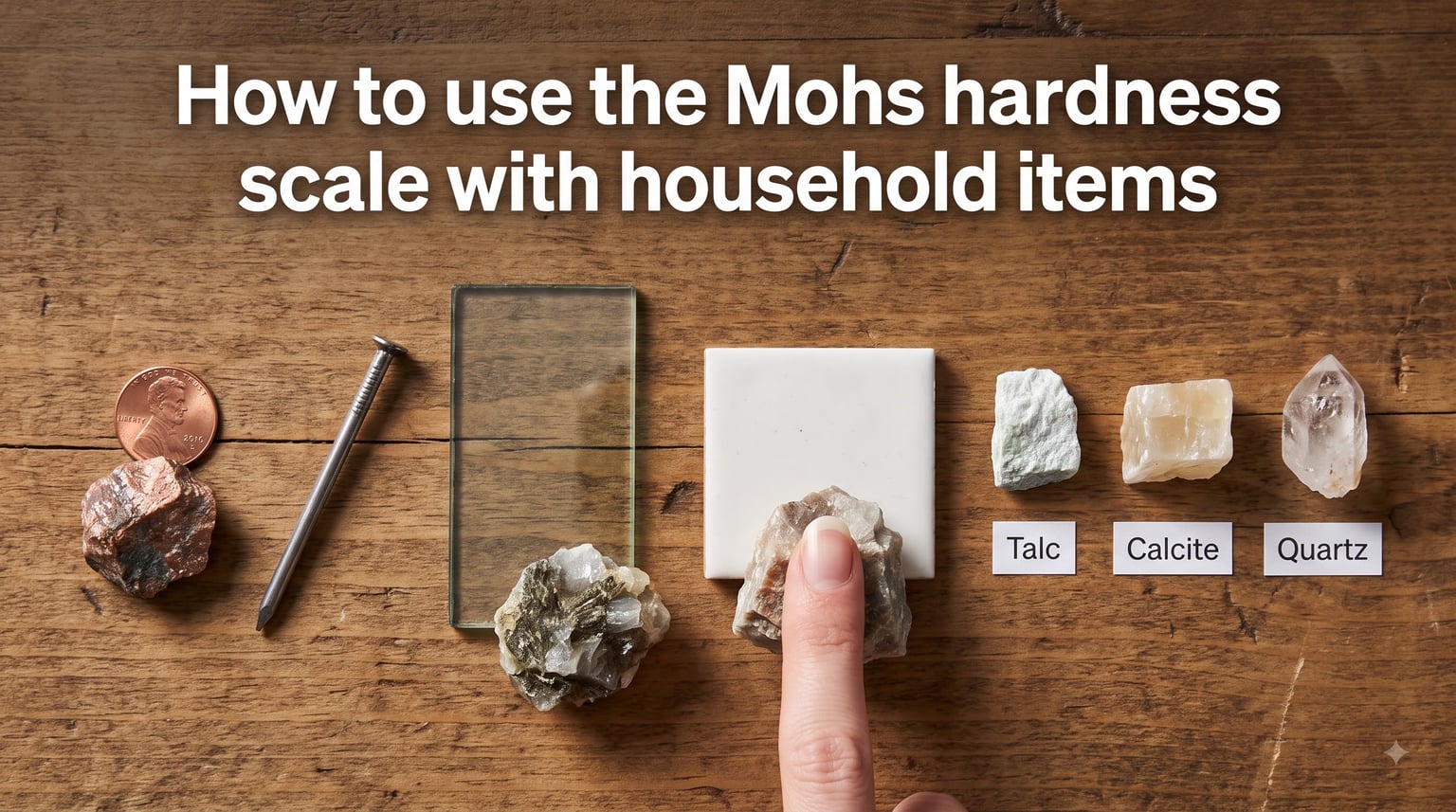
I remember the first time I tried to identify an unknown rock from a hiking trip. I stared at my collection for an hour with no clue what I had picked up. That changed once I learned how to use the Mohs hardness scale with household items.
The Mohs hardness scale is the simplest tool a beginner can use to start identifying minerals at home. You do not need fancy lab equipment. Your fingernail, a coin, and a steel nail are enough to narrow down most rocks you find. This guide walks you through the science, the household test kit, and the testing procedure so you can try it yourself.
Table of Contents
What Is the Mohs Hardness Scale
The Mohs hardness scale is a relative measure of scratch resistance that ranks ten minerals from 1 (softest) to 10 (hardest). It was created in 1812 by German mineralogist Friedrich Mohs.
Hardness, in this context, means how well a mineral resists being scratched by another material. A harder mineral will scratch a softer one, while the softer mineral leaves no mark. Because the scale is relative, the difference between 9 and 10 is far greater than between 1 and 2. Corundum (9) scratches easily, while diamond (10) resists nearly everything.
The scale uses ten index minerals as reference points. Talc sits at 1, gypsum at 2, calcite at 3, fluorite at 4, apatite at 5, orthoclase at 6, quartz at 7, topaz at 8, corundum at 9, and diamond at 10. Each mineral can scratch all minerals below it and can be scratched by all minerals above it.
The Mohs scale matters because it gives anyone a quick field test for mineral identification. Geologists, rockhounds, and gem dealers have relied on it for over 200 years. You can apply the same logic using common household items to approximate each level.
The 10 Minerals on the Mohs Scale Explained
Understanding the ten reference minerals on the Mohs scale makes household testing much easier. Here is each mineral, its hardness, and what it looks like in plain English.
Talc (1): The softest mineral. It feels soapy and you can scratch it with your fingernail. Baby powder is ground talc.
Gypsum (2): Slightly harder than talc. A fingernail (hardness 2.5) scratches it. Used in drywall and plaster.
Calcite (3): The main mineral in limestone and marble. A copper penny (3.5) just barely scratches it.
Fluorite (4): Often colorful crystals. A steel knife or glass plate scratches it.
Apatite (5): The mineral in your tooth enamel. A window glass piece (5.5) scratches it with effort.
Orthoclase (6): A common feldspar in granite. Cannot be scratched by a knife blade.
Quartz (7): One of the most common minerals in Earth’s crust. Scratches glass easily. White beach sand is mostly quartz.
Topaz (8): Harder than most household tools. You will need a special kit to test above 7.
Corundum (9): Includes ruby and sapphire. Industrial abrasive material.
Diamond (10): The hardest natural substance. Only a diamond can scratch another diamond.
Your fingernail sits around 2.5, which means it can scratch gypsum (2) but not calcite (3). Knowing these mid-range values lets you test rocks without owning an entire mineral collection.
Household Items and Their Mohs Hardness Values
You can build a working Mohs test kit from items already in your kitchen or junk drawer. Here is the comparison table you should save for your next rockhounding trip.
| Household Item | Approximate Mohs Hardness | What It Can Scratch |
|---|---|---|
| Fingernail | 2.5 | Talc, Gypsum |
| Copper penny (pre-1982) | 3.5 | Gypsum, Calcite |
| Steel needle / iron nail | 4.0 to 5.0 | Fluorite, Apatite (with effort) |
| Glass plate or bottle | 5.5 | Apatite, Fluorite, Calcite |
| Steel knife blade | 6.0 | Apatite (5), Orthoclase (6) borderline |
| Hardened steel nail / file | 6.5 | Orthoclase, anything below 6.5 |
| Porcelain tile (unglazed) | 7.0 | Quartz and most silicates |
| Sandpaper (silicon carbide) | 9.0 | Topaz, Corundum testing |
I keep a steel nail, a piece of glass, and an old copper penny in a small tin. That kit covers the most useful range, from gypsum up to quartz. Anything harder than quartz is rare in everyday rock collections.
Pre-1982 US pennies are solid copper (3.5) and work better than modern zinc pennies (3.0). If you only have newer pennies, your fingernail (2.5) becomes your best lower-end tool instead.
How to Perform a Mohs Hardness Test at Home
Follow this exact procedure whenever you test an unknown mineral. We have used these steps during our March for Science SV field activities and they produce consistent results.
Pick a fresh surface. Choose an unweathered spot on your specimen. Dirt and rind hide the true hardness.
Start with your fingernail. Press and drag your nail firmly across the rock. If you see a clear groove or powder, the hardness is below 2.5.
Move to a copper penny. Try to scratch the rock with the edge of the penny. A real scratch leaves a visible groove you can feel with your fingertip. Dust is not a scratch.
Test with glass or a knife blade. Drag a glass shard or steel knife across the surface. If the rock scratches glass cleanly, it is at least 5.5 to 6.
Finish with a hardened steel file. A 6.5 hardness nail or file tells you whether the rock is softer or harder than quartz.
Work from softest to hardest. Always test low before high. Going straight to a knife can destroy a delicate specimen you wanted to keep.
The most common beginner mistake is confusing dust with a scratch. Real Mohs hardness scratches leave a definite groove. Loose powder means the materials are similar in hardness and the test is inconclusive. Try a different spot or a slightly harder item.
Apply steady, medium pressure. Pressing too hard crushes the rock. Pressing too lightly gives a false negative. Think of it like writing with a ballpoint pen, firm but controlled.
Tips and Safety for Accurate Hardness Testing
A few practical habits separate casual testers from people who actually get reliable mineral IDs at home.
Wear safety glasses when testing with glass shards or knife blades. Chips fly.
Test on a flat, well-lit surface so you can see grooves clearly.
Clean your test tools between rocks. Stray quartz grit can fake a higher hardness.
Accept ranges. A rock that resists a knife but yields to a steel file (6.5) sits between 6.0 and 6.5.
Combine hardness with other tests. Color, streak, luster, and cleavage tell you more than hardness alone.
Avoid testing soft minerals like gypsum on humid days. Moisture changes how they scratch.
The Mohs scale is relative, not linear. The jump from 9 to 10 is roughly four times larger than the jump from 1 to 2 in absolute terms. For most home identification, that distinction does not matter. You will rarely meet a diamond loose on a beach.
Frequently Asked Questions
What is the Mohs scale trick?
The Mohs scale trick is to memorize four everyday reference points: your fingernail (2.5), a copper penny (3.5), a steel knife or glass plate (5.5), and a hardened steel nail (6.5). Using just those items covers most rocks you will encounter and lets you sort minerals in minutes.
What would you use the Mohs hardness scale for?
The Mohs hardness scale is used to identify unknown minerals in the field, distinguish look-alike rocks, test jewelry and gemstones, run geology classroom activities, and select materials for construction or lapidary work. Rockhounds rely on it most when a specimen has no labels.
What is the Mohs hardness scale for everyday use?
For everyday use, the Mohs scale gives you a quick way to test whether an unknown rock is soft (scratched by a fingernail), medium (scratched by a coin or glass), or hard (scratches glass and steel). That single test narrows your mineral list dramatically before any other identification step.
How to do a Mohs hardness test at home?
To do a Mohs hardness test at home, choose a fresh surface on the rock, then try to scratch it with items of known hardness in order: fingernail, copper penny, glass or steel knife, then a hardened steel file. The hardest item that fails to scratch the mineral sets its Mohs value as a range.
Start Testing Minerals at Home Today
You do not need a professional lab to start identifying minerals with the Mohs hardness scale and household items. Grab a coin, a nail, and a piece of glass, then test your next collected rock.
The scale rewards practice. Within a few specimens you will start spotting quartz, calcite, and feldspar on sight. Keep notes, stay safe, and you will be surprised how much geology you can do with your kitchen drawer.